
Claims are rarely denied — they are trimmed. Here is the six-part evidence package that stops the trimming before it starts.
Why good claims get reduced
Most restoration claims are not denied outright. They are trimmed — a line item here, two days of equipment there, a contents allowance halved — until the settlement no longer covers the work. Almost every reduction traces back to the same root cause: the file did not prove what it asserted.
An adjuster is not a hostile party by default. They are an evaluator working from a file, applying a policy document and industry pricing software to whatever evidence reaches their desk. Evidence that is missing does not get the benefit of the doubt; it gets removed from the estimate.
The one-sentence rule
If it is not photographed, measured, logged or invoiced, it did not happen — as far as the claim is concerned.
Read the declarations page before you read anything else
Before the first phone call, spend ten minutes with the declarations page — the summary sheet at the front of your policy. Five numbers determine everything that follows.
| Item | What to look for | Why it matters |
|---|---|---|
| Coverage A | Dwelling limit | Caps structural repairs |
| Coverage B | Other structures | Detached garage, fence, shed |
| Coverage C | Personal property limit | Contents; often 50–70% of Coverage A |
| Coverage D | Loss of use / additional living expense | Hotel and meals while displaced |
| Deductible | Flat or percentage | Hurricane deductibles are often 2–5% of the dwelling limit |
Two distinctions cause more disputes than anything else. The first is replacement cost value (RCV) versus actual cash value (ACV): ACV subtracts depreciation, so a ten-year-old roof pays out at a fraction of a new one. Many policies pay ACV first and release the depreciation holdback only after the work is completed and invoiced — which is why you must submit final invoices, not just estimates.
The second is flood versus water damage. Standard homeowner policies exclude flood, defined as rising surface water. Flood is covered by separate NFIP or private flood policies. A burst pipe is water damage; two feet of storm surge is flood. The same wet carpet, two entirely different claims.
The evidence package that survives review
A complete restoration claim file has six parts. Build all six from day one and reviews get shorter, not longer.
1. Photographic record
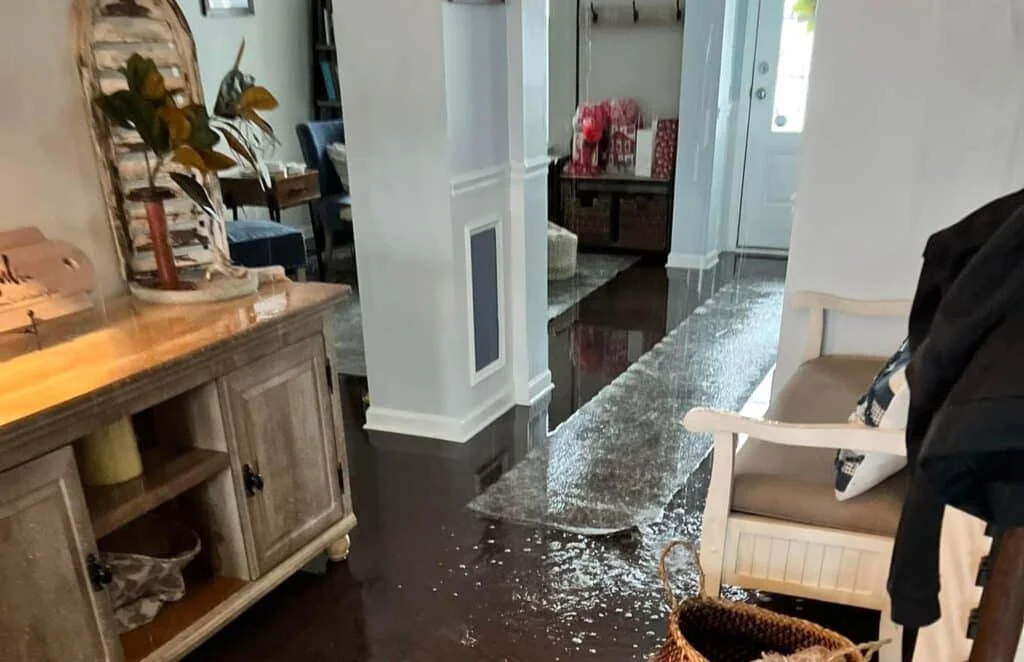
Wide shots of every room from two corners, before anything is moved. Close-ups of damaged materials with a tape measure or a coin in frame for scale. Photographs of the source. Photographs of the equipment in place with the serial numbers visible. Then a matching set after completion, taken from the same positions.
2. Moisture and psychrometric logs
Daily readings of chamber temperature, relative humidity, grains per pound, and material moisture content at fixed mapped positions. This is what justifies equipment days — the single most commonly trimmed line item.
3. Scope of work
A room-by-room, line-by-line description of what will be done, with quantities. Adjusters compare this against Xactimate pricing, so the closer your scope matches Xactimate's line-item structure, the fewer questions.
4. Contents inventory
Item, description, age, original cost, and a photograph. Group by room. Mark each item restorable, non-restorable or already restored.
5. Correspondence log
Date, time, who you spoke to, what was said, what was agreed. Follow every significant phone call with a short email that begins “To confirm our conversation today…”. A written summary the other party does not dispute is evidence.
6. Invoices and receipts
Including hotel, meals and laundry if you are displaced and carry loss-of-use coverage. Keep everything, even the small items — they add up to real money over a three-week displacement.
Understanding Xactimate without becoming an estimator
Most US carriers price restoration work using Xactimate, a database of line items with regional unit pricing updated monthly. You do not need to own the software, but you should understand three things about it.
Line items are granular. “Dry the bedroom” is not a line item. “Air mover (per 24-hour period)”, “Dehumidifier — LGR (per 24-hour period)”, “Remove and dispose carpet pad”, “Apply antimicrobial agent (per SF)” are. A scope written in plain English gets translated by someone else — and translation loses items.
Pricing is regional and dated. The same line item costs differently in Miami and in Boise, and the price list version matters after a major catastrophe when material costs spike. If your estimate uses a price list from three months before a hurricane, it understates current cost.
Overhead and profit (O&P) is a separate line. Where three or more trades are involved, general-contractor overhead and profit — typically 10% and 10% — is customarily included. It is frequently omitted from a first estimate and frequently added back on request.
Ask for the estimate file, not the summary
Request the full Xactimate PDF with all line items, not the one-page summary. Compare it line by line against your contractor's scope. Missing items are usually oversights, and oversights get corrected when pointed out politely and specifically.
What to do when you disagree
Escalation has a natural order, and skipping steps rarely helps.
- Line-item rebuttal. Write to the adjuster with each disputed item, the reason it belongs, and the evidence that supports it. Attach the photographs and log pages by reference number.
- Re-inspection. Request that the adjuster or a supervisor revisit the property with your contractor present. Many disputes evaporate when both parties stand in the same room.
- Appraisal clause. Most policies contain an appraisal provision: each side appoints an appraiser, and the two appoint an umpire. It is faster and cheaper than litigation and binding on the amount of loss — though not on coverage questions.
- State insurance department complaint. Every state has a regulator that accepts consumer complaints. Carriers respond to these promptly because they are tracked.
- Public adjuster or attorney. Public adjusters work for you for a percentage (commonly 10–20%). Worth considering on large, complex or stalled claims; rarely worth it on small ones.
Deadlines that quietly expire
Policies carry time limits, and they are enforced. The specific numbers vary by carrier and state, but the categories are consistent.
- Prompt notice. Report the loss “promptly” or within a stated number of days. Florida, for example, has tightened notice windows for property claims in recent years — check your state's current rule.
- Proof of loss. Often due within 60 days of the carrier's request. Missing it can be fatal to the claim.
- Suit limitation. Many policies limit the period in which you may bring an action, commonly one to five years from the date of loss.
- Depreciation recovery. The holdback between ACV and RCV usually must be claimed within a set window after completion, with final invoices attached.
Put every one of these dates in a calendar the week the claim opens.
The claim file checklist
Print this and keep it with the file
- Declarations page reviewed; deductible and coverage limits noted
- Claim opened, claim number and adjuster contact recorded
- Pre-mitigation photographs and video of every affected room
- Source of loss photographed, including appliance serial plate
- Emergency mitigation authorised in writing
- Moisture map with labelled positions
- Daily psychrometric and material readings
- Equipment list with run hours
- Room-by-room scope of work in line-item form
- Contents inventory with photographs and values
- Correspondence log with dated summaries
- All invoices and receipts, including living expenses
- Post-completion photographs from matching angles
- Final invoice submitted for depreciation recovery
None of this requires special software or professional training. It requires doing the boring thing on the first day, when the temptation is to do anything else.
Dealing with this right now?
Our dispatch desk is staffed 24/7. Call +1 888-216-6362 or request an appointment and a coordinator calls you back in minutes.