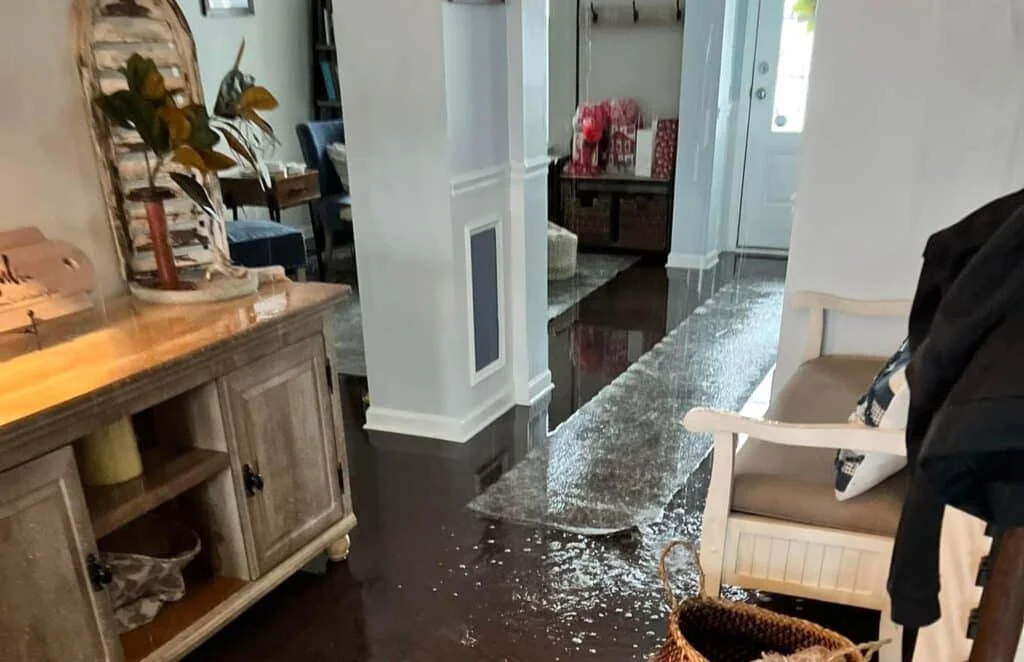
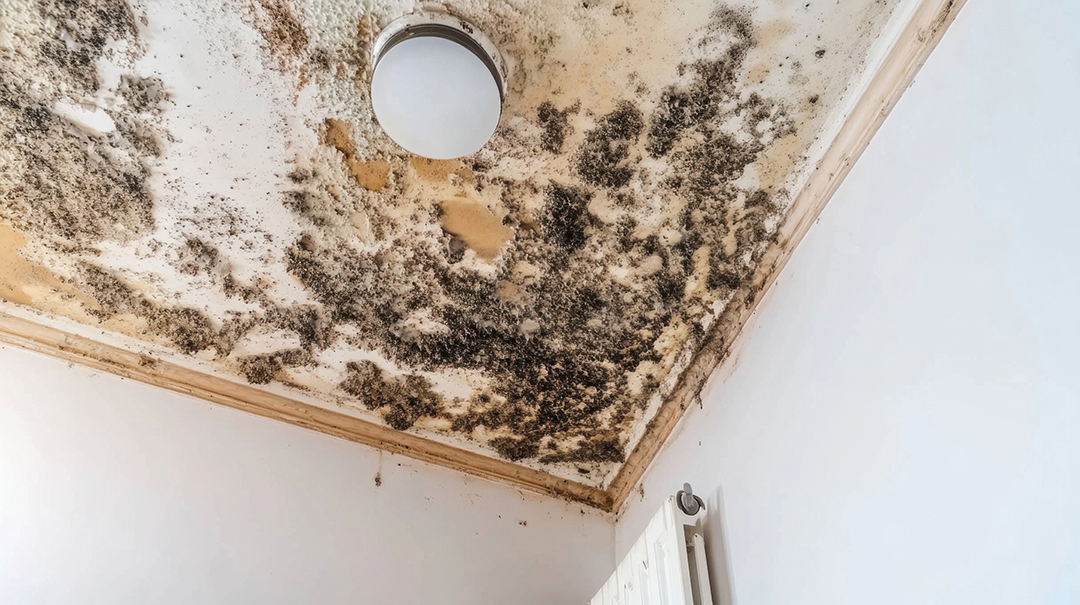
Mold control is moisture control. Everything else — species names, colour, spray-on products — is downstream of that one fact.
Four things mold needs, and only one you control
Mold is not an infestation that arrives from outside. Spores are already present in every building on earth, indoors and out, in numbers measured in the thousands per cubic metre of ordinary air. They are inert until four conditions align.
| Requirement | Present in your building? |
|---|---|
| Spores | Always. Removing them entirely is impossible. |
| Food source | Always. Drywall paper, wood, dust, adhesives, textiles. |
| Temperature | Almost always. Most species thrive between 40 °F and 100 °F. |
| Moisture | The only variable you control. |
That is the entire discipline in one line: mold control is moisture control. Every product marketed as a mold killer is downstream of that fact. If the moisture source remains, the growth returns — on the same wall, in the same month.
The 24–48 hour window
Under favourable conditions, visible colonisation on wet cellulose materials can begin within 24 to 48 hours. This is why the drying deadline in water damage work is not arbitrary.
Water activity: the number professionals actually use
Relative humidity describes air. Water activity (aw) describes materials — the availability of water within a substance on a scale from 0 to 1. It is what determines whether a specific species can grow on a specific surface.
- aw < 0.70 — practically no fungal growth.
- 0.70–0.80 — xerophilic species such as Aspergillus restrictus can establish.
- 0.80–0.90 — most Aspergillus and Penicillium species flourish.
- > 0.90 — hydrophilic species including Stachybotrys chartarum require sustained saturation, which is why it appears on chronically wet drywall rather than after a quickly dried spill.
In practice, keeping indoor relative humidity below 60% — ideally between 30% and 50% — keeps material water activity below the threshold for most species. A hygrometer costs less than twenty dollars and is the single most useful diagnostic instrument a property owner can own.
What the health evidence does and does not say
Public discussion of mold swings between dismissal and panic. The evidence supports something in between.
Well-established: damp indoor environments are associated with respiratory symptoms, coughing, wheezing, worsening of asthma, and hypersensitivity reactions in sensitised individuals. Institutions including the WHO and the US CDC recognise the association between building dampness and respiratory health effects.
Not established: the popular idea that a specific species — usually Stachybotrys, the "black mold" of headlines — reliably causes a distinct syndrome of severe systemic illness in otherwise healthy adults. Colour is also a poor guide; many species are dark, and many dark growths are harmless.
The practical consequence is important: species identification rarely changes the remediation plan. The response to visible growth over a given area is the same regardless of which species it turns out to be. Money spent on speciating a visible colony is usually money not spent on removing it.
Who needs extra caution
Infants, elderly residents, people with asthma or COPD, and anyone immunocompromised should stay out of an affected area entirely until remediation and clearance are complete.
Assessment: finding the water before looking at the mold
A competent assessment answers three questions in order: where is the water coming from, how far has it travelled, and what has it affected?
Instruments
- Thermal imaging shows temperature anomalies where evaporative cooling suggests moisture — a scanning tool, not a moisture meter.
- Non-penetrating meters scan large areas for relative differences.
- Penetrating meters confirm actual moisture content at depth.
- Borescopes inspect wall cavities through a small hole rather than by demolition.
- Hygrometers establish the psychrometric conditions driving the problem.
When testing is worth it
Air sampling is useful in three situations: when growth is suspected but not visible, when a tenant or buyer requires objective evidence, and as post-remediation clearance. It is not useful for deciding whether visible growth on a bathroom ceiling needs cleaning. If you can see it, you already have your answer.
How remediation actually works
Professional remediation in North America follows the IICRC S520 standard. Scale determines method; principles stay constant.
Condition classes
- Condition 1 — normal fungal ecology. The goal state.
- Condition 2 — settled spores and fragments, no active growth.
- Condition 3 — actual growth and amplification present.
The sequence
- Fix the moisture source. Nothing else proceeds until this is done and verified.
- Containment. 6-mil polyethylene barriers, sealed at edges, with a decontamination chamber for anything over about 100 square feet of growth.
- Negative air pressure. HEPA-filtered air scrubbers exhausted outside, maintaining containment at negative pressure relative to surrounding space so nothing migrates out.
- Removal. Porous materials with growth — drywall, insulation, carpet, ceiling tile — are cut out and bagged inside the containment. Semi-porous and non-porous surfaces are HEPA vacuumed and damp-wiped.
- Cleaning. Detailed HEPA vacuuming and wiping of every surface in the containment, including the framing.
- Drying to standard. The assembly is dried to the documented dry standard before it is closed up.
- Clearance. An independent third party verifies the result.
Why bleach is the wrong tool
Household bleach is mostly water. On porous materials it bleaches the pigment — removing the visible stain while the hyphae below survive in the water the bleach just delivered. The result looks clean and regrows. On non-porous surfaces bleach is a legitimate disinfectant; on drywall and wood it is theatre.
What clearance really means
Clearance is the moment a qualified, independent party certifies that the remediated area has returned to Condition 1. It has three components, and skipping any one of them makes the certificate worthless.
- Visual inspection. No visible growth, no debris, no remaining moisture damage.
- Moisture verification. Materials at or below the documented dry standard.
- Air or surface sampling compared against an outdoor control sample taken the same day. Indoor spore counts and species profile should be equal to or better than outdoors.
The outdoor control matters more than people expect. There is no universal numeric pass mark for indoor spore counts; the meaningful comparison is against the ambient air outside the same building at the same time.
Independence is the point
The company that performs remediation should not perform its own clearance test. Reputable remediators insist on a third-party hygienist precisely because it protects the client, the insurer and the contractor's own record.
Preventing the next one
- Keep indoor RH between 30% and 50%; verify with a hygrometer, not by feel.
- Run bathroom extraction for 20 minutes after showering, and confirm it discharges outside — not into the attic, which is a shockingly common construction defect.
- Ensure the clothes dryer vents outdoors and the duct is clear.
- Insulate cold-water pipes to stop condensation dripping inside wall cavities.
- Fix any leak within 24 hours. Not "soon" — 24 hours.
- Never carpet a bathroom or basement slab.
- Service HVAC drain pans and condensate lines annually; a blocked condensate line floods a ceiling silently.
- Investigate any musty smell immediately. The nose detects microbial volatile organic compounds long before growth is visible.
Mold remediation is expensive, disruptive and entirely avoidable. Every dollar spent on humidity control and prompt leak repair displaces roughly ten spent on containment, demolition and clearance.
Dealing with this right now?
Our dispatch desk is staffed 24/7. Call +1 888-216-6362 or request an appointment and a coordinator calls you back in minutes.