Three separate kinds of damage, four types of smoke residue and one odour problem that decides whether the whole project succeeded.
A fire causes three separate kinds of damage
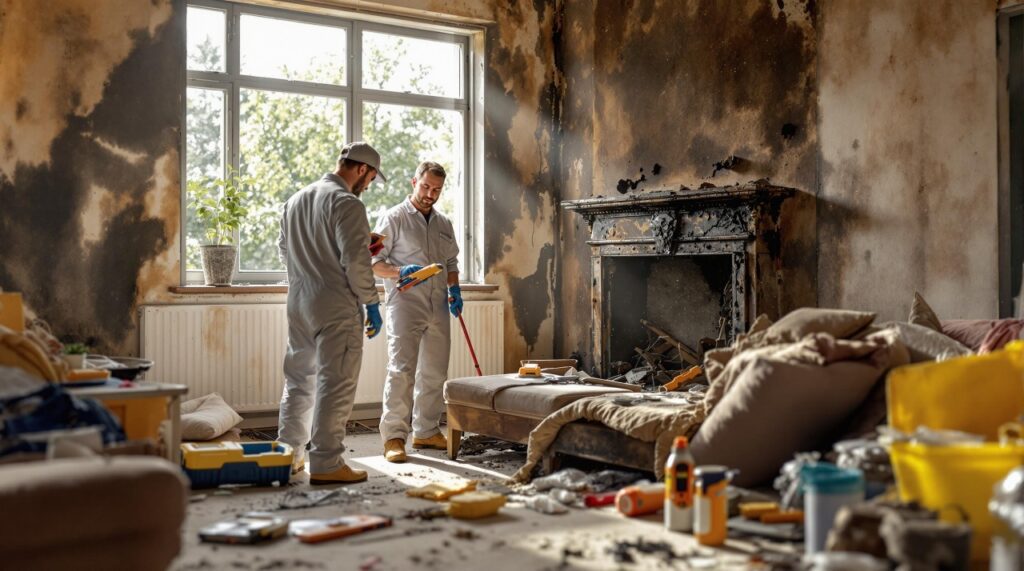
People picture fire damage as burnt structure. In most residential and commercial fires, combustion damage is the smallest of three problems.
- Thermal damage — what actually burned, charred or melted.
- Smoke and soot damage — residues deposited on every surface the smoke reached, usually the entire building.
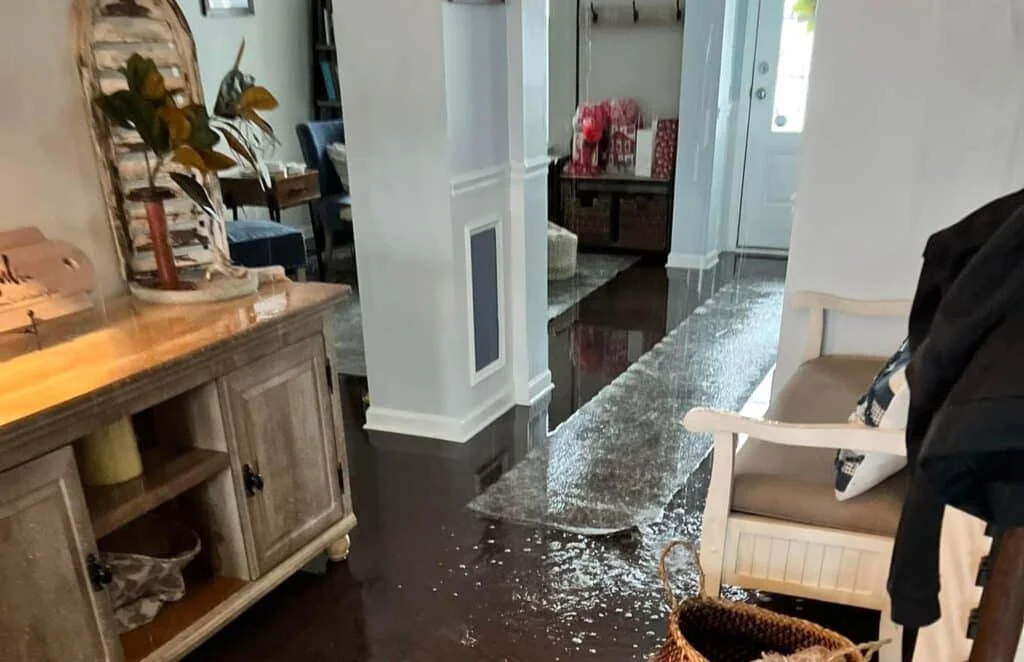
- Water and suppression damage — from hoses and sprinklers, often thousands of gallons, plus the chemical residue of extinguishing agents.
A kitchen fire contained to one wall routinely produces soot damage in every room, water damage on two floors, and an odour problem that outlives both. Restoration sequencing exists to handle all three without letting one make the others worse.
Soot is corrosive and it is working right now
Smoke residues are acidic. Within 24 hours they discolour grout and plastics; within 72 hours they etch glass, pit chrome and corrode electrical contacts. Delay does not pause the damage — it compounds it daily.
The first hours: securing the structure
Nothing productive happens until the building is safe and closed.
Re-entry authorisation
The fire department decides when a structure may be re-entered. Even when the fire is out, hazards persist: compromised framing, weakened floors, hidden hot spots in cavities, and air that may still carry combustion products. Do not enter to "grab a few things" before clearance.
Emergency board-up and tarping
Openings created by fire or fire-fighting are secured with plywood; damaged roofs are tarped. This serves three purposes: it keeps weather out, it keeps people out, and it satisfies the policy's duty to prevent further damage. Insurers reimburse it; failing to do it can prejudice the claim.
Utilities and stabilisation
Gas is capped, electrical is isolated and inspected before any temporary power is set. Temporary power for drying equipment usually comes from a generator or a dedicated temporary panel, not from the damaged service.
Water removal — immediately
Suppression water is treated as a water loss in its own right and extracted the same day. Left in place, it creates a mold problem inside 48 hours that arrives on top of everything else.
Reading the smoke: four residue types, four cleaning methods
What burned determines what the residue is, and the residue determines the method. Applying the wrong one drives soot deeper into a surface and can make it permanent.
| Residue | Source | Character | Approach |
|---|---|---|---|
| Dry smoke | Fast, high-temperature, well-oxygenated fires (paper, wood) | Powdery, non-smeary | Dry sponging and HEPA vacuuming first; wet cleaning only afterwards |
| Wet smoke | Slow, low-heat, smouldering fires (plastics, rubber) | Sticky, thick, strong odour | Solvent-based cleaners, extensive agitation, often multiple passes |
| Protein residue | Kitchen fires — burnt food and fat | Nearly invisible, discolours paint and varnish, intense odour | Degreasing agents, enzyme cleaners, full surface treatment even where nothing is visible |
| Fuel oil soot | Furnace puff-back | Oily, pervasive, deeply staining | Specialist solvents; textiles usually require off-site processing |
A crew that starts wet cleaning dry smoke residue turns removable powder into a smeared stain. This is the single most common mistake made by well-meaning owners in the first 48 hours.
Contents: pack-out, triage and what genuinely cannot be saved
Contents restoration is usually cheaper than replacement and always faster to settle with an insurer. The process is systematic.
Inventory and triage
Every item is photographed, barcoded and classified as restorable, non-restorable or high-priority (documents, heirlooms, business records). The inventory becomes the contents portion of the claim.
Pack-out
Restorable items move to a climate-controlled facility where they can be processed while the structure is being repaired — which also removes them from the odour source.
Processing methods
- Ultrasonic cleaning for hard non-porous items — cavitation reaches detail a cloth cannot.
- Textile restoration using ozone chambers or specialist laundering for clothing, drapes and soft furnishings.
- Document recovery by vacuum freeze-drying for paper and books soaked in suppression water.
- Electronics — corrosion inhibitors and specialist board cleaning, but only by a technician who does this specifically.
Discard, always
Food (including sealed cans and jars — seals fail and heat spoils contents), medications, cosmetics, single-use medical supplies, and anything porous that has absorbed protein residue. No cleaning method makes these safe again.
Odour: the part that determines whether the job succeeded
You can restore a structure perfectly and still fail, because the client walks in and smells the fire. Odour removal is a four-stage discipline and every stage is mandatory.
- Remove the source. Charred materials, saturated insulation and unsalvageable porous contents leave the building. No amount of deodorising overcomes remaining source material.
- Clean every surface. Including cavities, ductwork, the tops of joists, and the interiors of cabinets. Odour molecules are deposited wherever smoke travelled.
- Treat the air and porous materials. Hydroxyl generators work safely in occupied spaces over several days. Ozone is faster and stronger but requires full evacuation of people, pets and plants, and must be followed by a ventilation period. Thermal fogging pairs a deodorising agent with heat so it penetrates the same pores that smoke did.
- Seal what remains. Shellac-based or specialist odour-blocking primers on framing and subfloor before reconstruction. This is the last resort, not the first move.
Skipping stage one and jumping to stage four — sealing over the problem — produces a building that smells fine for six weeks and then does not, usually on the first humid day.
A realistic timeline
| Phase | Typical duration | What happens |
|---|---|---|
| Emergency | Day 1–2 | Board-up, tarping, water extraction, utilities secured |
| Assessment | Day 2–4 | Scope written, contents inventoried, adjuster walkthrough |
| Pack-out | Day 3–7 | Contents removed to processing facility |
| Demolition | Day 5–12 | Unsalvageable materials removed, structure cleaned to framing where needed |
| Cleaning & deodorising | Day 8–20 | Surface cleaning, duct cleaning, hydroxyl or ozone treatment |
| Reconstruction | Week 3–12 | Rebuild, finishes, contents return |
A contained single-room fire typically completes in three to five weeks. A whole-structure fire runs three to six months, dominated by the reconstruction phase and by permitting.
Choosing a fire restoration contractor
- IICRC FSRT (Fire and Smoke Restoration Technician) certification on the crew, not just on the website.
- In-house contents processing, or a named partner facility you can visit.
- A written scope before demolition begins — never after.
- Daily photo documentation shared with you, not filed away.
- Clear separation between the mitigation contract and the reconstruction contract.
- Willingness to explain which smoke residue type they identified and why they chose their method.
That last point is the best single test. A contractor who can explain in plain words why they are dry-sponging one room and solvent-cleaning another is a contractor who knows what they are doing.
Dealing with this right now?
Our dispatch desk is staffed 24/7. Call +1 888-216-6362 or request an appointment and a coordinator calls you back in minutes.